







- Buying Guide
- Reading time: 10 min
How to Buy Mexican Restaurant Furniture in the US
For restaurant owners who want authentic Mexican furniture — equipales, painted chairs, booths, Talavera and solid-wood tables — and need to know where it comes from, what to check and how to order it.
The short version. Authentic Mexican restaurant furniture is made in Jalisco: carved and painted wood, booths and tables in Tonalá and Guadalajara, equipales around Zacoalco. You can buy it factory-direct from a manufacturer that exports to the US, through an importer or Mexican-goods store, or piece by piece on artisan marketplaces. For a full dining room, only factory-direct gets you matching pieces, commercial-grade construction and one party accountable from the workshop to your door.
Section 1
Where Mexican Restaurant Furniture Actually Comes From
When a restaurant in Texas or California has “that look” — carved chair backs, hand-painted flowers, a leather equipal in the corner — the pieces almost always trace back to Jalisco, in western Mexico.
Tonalá, on the east side of the Guadalajara metro area, is the craft town: woodworking, ironwork, ceramics and upholstery are family trades, often two or three generations under one roof. Guadalajara is where the larger, export-oriented shops build booths in volume, stock commercial vinyl and crate furniture for the border. MF Imports works from its own workshop in Tonalá and a network of partner workshops, and exports from Jalisco to the US.
The equipal has its own geography: the Zacoalco de Torres area, south of Guadalajara, where families have made the same chair for generations — a frame of wooden strips with a seat and back of tanned natural leather, usually pigskin. It is still made by hand.
Why it matters: “Mexican-style” furniture is also mass-produced elsewhere under the same name. Ask where a piece is built and by whom — a manufacturer answers with a city and a workshop; a reseller usually cannot.
Section 2
The Main Types of Mexican Restaurant Furniture
Most Mexican restaurants in the US mix three or four of these. Each family has its own page: equipales, chairs, booths, tables, rustic furniture and decor.
Equipales
Leather-and-wood chairs, armchairs, stools and small tables from Jalisco. Light enough to move daily, sturdy enough for years of service. The go-to for cantinas and patios.
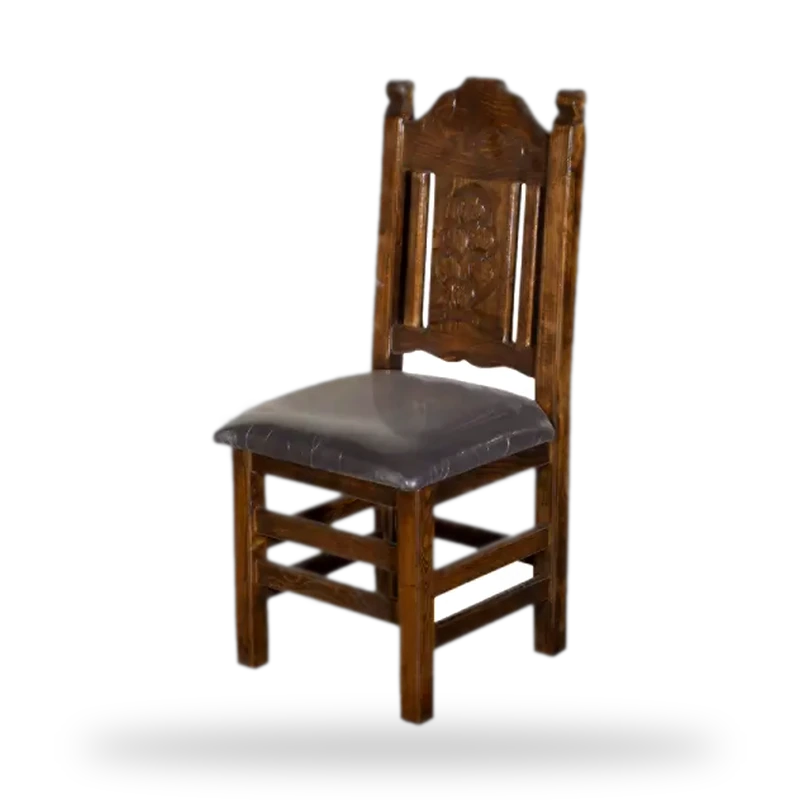
Carved & hand-painted chairs
Solid pine frames with carved or cut-out backs, hand-painted in your palette and sealed for commercial use. The most flexible chair for a full buildout.
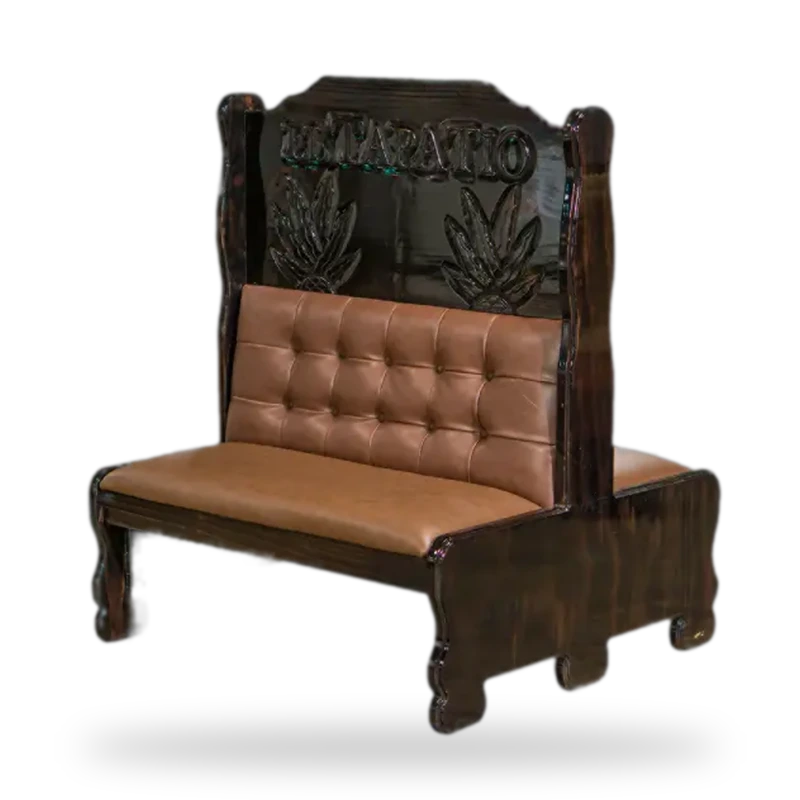
Upholstered booths
Solid-wood frames in commercial vinyl, built in modular sections that run the length of a wall or stand back-to-back mid-room. The piece that most affects seating capacity.
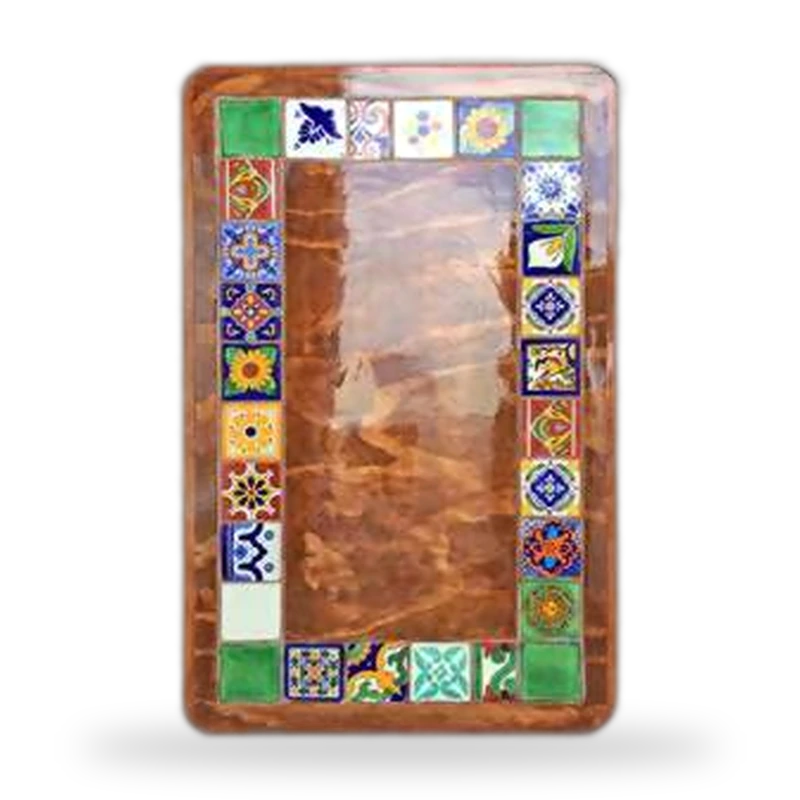
Talavera-tile tables
Wood or iron bases with hand-glazed ceramic tile tops. Wipe-clean, colorful and unmistakably Mexican. Best on patios and in casual dining.
Rustic solid-wood tables
Thick tops in pine, parota or mesquite, stained rather than painted. The hacienda look. Heavier, so settle the layout before they arrive.
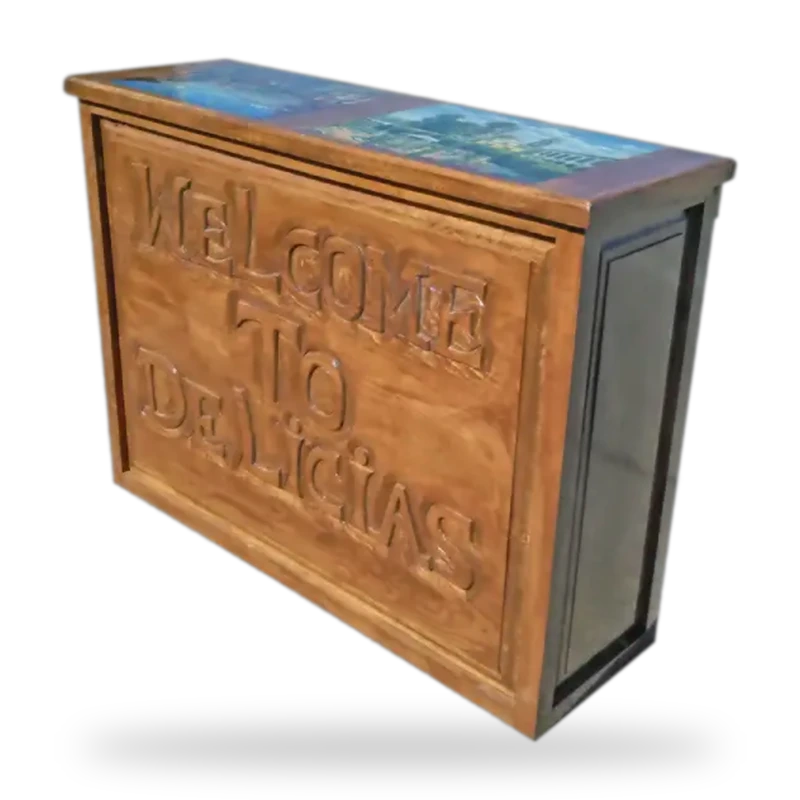
Bars, stools & decor
Bar fronts, stools, mirrors, iron sconces and tin or ceramic accents. Ordered last, but they should share the seating’s stain and vinyl.
Section 3
Factory-Direct, Importer, or Marketplace?
There are three realistic ways to get Mexican furniture into a US restaurant. The mistake is using the wrong one for a full dining room.
| Channel | How it works | Strengths | Watch out for | Best for |
|---|---|---|---|---|
| Factory-direct | You order from the manufacturer in Mexico; it builds to spec, crates the order and delivers to your restaurant. | Exact colors and dimensions, commercial-grade build, no importer margin, one accountable party. | Made to order, so plan for the lead time. Ask for a landed quote to your address, not an ex-works price. | Full buildouts, chains, anyone who needs matching sets. |
| Importer / Mexican-goods store | A US business buys from workshops in Mexico, warehouses the pieces and resells them. | You can see and touch the piece today; no customs to think about. | Limited to stock on hand; colors and sizes rarely match across pieces; a margin on top of the factory price. | A few accent pieces, or replacing one broken chair fast. |
| Online artisan marketplaces | Makers list one-off pieces, often shipped from Mexico by parcel. | Unique decorative items and genuine handmade character. | No commercial grading or restaurant sealer, unpredictable shipping, no way to reorder the same piece later. | Decor and wall pieces — not seating. |
Wholesale is a price tier, not a channel. At MF Imports there is no minimum order — a single chair is built to the same standard as a full dining room — and larger orders get a volume quote. Furnishing several locations? See wholesale Mexican furniture.
Section 4
What to Check Before You Order
A chair that looks right in a photo can still fail in a restaurant. Ask any supplier, including us:
Is it built for commercial use?
Restaurant seating is sat on, dragged and wiped down every day. Ask about the joinery (mortise-and-tenon or doweled frames, not stapled) and the wood. We build in pine, parota and mesquite; equipales use sabino or pirul.
What is on top of the paint?
Hand-painted furniture needs a clear commercial sealer or lacquer, or it wears through at the armrests and seat edges. Ask what the topcoat is and whether it takes cleaning chemicals.
Stain or paint?
Stain shows the grain and hides scratches; paint gives an exact brand color. We stock 8 water-based wood stains (Sayer Aquagel) and paint to order — decide per piece, not per room.
Which vinyl, and which fire rating?
Upholstery-grade vinyl is the difference between a booth that lasts and one that cracks. Ours is Maclin upholstery vinyl in 82 tones. Properties change by line: some lines meet California Bulletin 117, Section E, others do not. Get the brand, line and fire rating in writing.
Do the dimensions fit your floor plan?
Booths are the piece to measure twice: they are built to length and cannot be trimmed on site. Leave at least 36 in (about 90 cm) of aisle between rows, and check door widths for back-to-back sections. Everything can be made to measure, so send a floor plan.
Can it be reordered?
A manufacturer keeps your color and model on file; a one-off marketplace piece cannot be matched a year later.
Section 5
How to Order Factory-Direct, Step by Step
Same process for six equipales or a full dining room. Colors are previewed in the online visualizer; the quote is requested through the contact page.
-
Count seats and measure the room
Booth sections per wall, two- and four-tops, stools at the bar. Note door widths — a back-to-back booth has to fit through them.
-
Pick the models
Browse chairs, booths, tables and equipales, or send photos of the look you want. Mixing families is normal.
-
Choose colors in the visualizer
Each product is shown in 82 vinyl tones and 8 wood stains, with seat, back and frame chosen separately — up to 52,480 combinations for one piece. The textures are photographs of the real swatches.
-
Request the quote
Send model, color, quantity and delivery address. Ask for a landed quote: product, crating, freight and delivery on one document. No minimum order.
-
Approve physical samples
Before a large order we send vinyl and stain samples at no cost. Production is matched to the physical sample, not the screen. Sign off on it and keep it for reorders.
-
Production and delivery
Delivery takes 8–10 weeks from order confirmation, production and shipping included. Each piece is inspected, crated and shipped from Jalisco to your restaurant.
Section 6
Shipping from Mexico to the US
This is what keeps most owners from buying directly from Mexico, and what a real exporter takes off your plate. Orders ship from Jalisco and are delivered anywhere in the US.
What to expect from any supplier that ships from Mexico:
A landed quote
Product, crating, freight and delivery on one page. If a quote is “ex-works” or “FOB Guadalajara”, freight and border costs are still yours.
Export-grade packing
Corner protection and crating, not shrink wrap. Ask how booths and tile tables are packed.
One point of contact
You never call a customs broker or freight line yourself; the supplier coordinates the crossing and final delivery.
An inspection window
Check the crates on arrival and photograph any damage before signing the receipt — that is what makes a freight claim possible.
Section 7
Common Mistakes When Buying Mexican Restaurant Furniture
Section 8
Pre-Order Checklist
Have these answers ready and the quote comes back faster.
The room
- Seat count by type: booths, chairs, stools, patio
- Wall lengths for booths and the door / delivery path width
- Models chosen for each area, or reference photos
- Opening date, so the lead time is planned
The finish
- Vinyl tone and wood stain, previewed in the visualizer
- Brand colors (paint codes) if chairs will be painted to match
- Vinyl line and fire rating confirmed in writing
- Commercial sealer or lacquer over painted finishes
The deal
- A landed quote: product, crating, freight and delivery
- Physical samples approved and kept on file
Section 9
Frequently Asked Questions
Where do Mexican restaurants get their furniture?
Most authentic pieces come from workshops in Jalisco, Mexico: Tonalá and Guadalajara for carved and painted wood, booths and tables; the Zacoalco area for equipales. US restaurants buy them factory-direct from a manufacturer that exports, through an importer or Mexican-goods store, or piece by piece on artisan marketplaces.
Can I buy Mexican restaurant furniture directly from the factory in Mexico?
Yes. MF Imports builds in its own workshop in Tonalá and a network of partner workshops, and sells factory-direct to restaurants anywhere in the US. You choose the model, vinyl and stain, request a quote and approve samples; we handle production, export and delivery.
Is there a minimum order for Mexican restaurant furniture?
No. There is no minimum order. A single chair is built to the same specification as a full dining room; larger orders get a volume quote.
What is an equipal?
An equipal is the traditional chair of Jalisco: a frame of wooden strips, usually sabino or pirul, with a seat and back of tanned natural leather, often pigskin. Lightweight and sturdy, it is the most requested chair for traditional and casual Mexican restaurants.
How do I make sure the colors match my restaurant?
Preview any product in the online visualizer in 82 vinyl tones and 8 wood stains, then approve physical samples before a large order. Screens vary, so the sample is the reference; we send it at no cost.
How long does delivery take?
Delivery takes 8–10 weeks from order confirmation, production and shipping included. Every order ships from Jalisco to anywhere in the US; we coordinate export paperwork, the border crossing and final delivery.
Next step
Ready to quote your dining room?
Send your seat count, the models you like and your address. You get a landed quote and samples — no minimum order, delivered anywhere in the US. More than 500 restaurants already furnish with MF Imports.